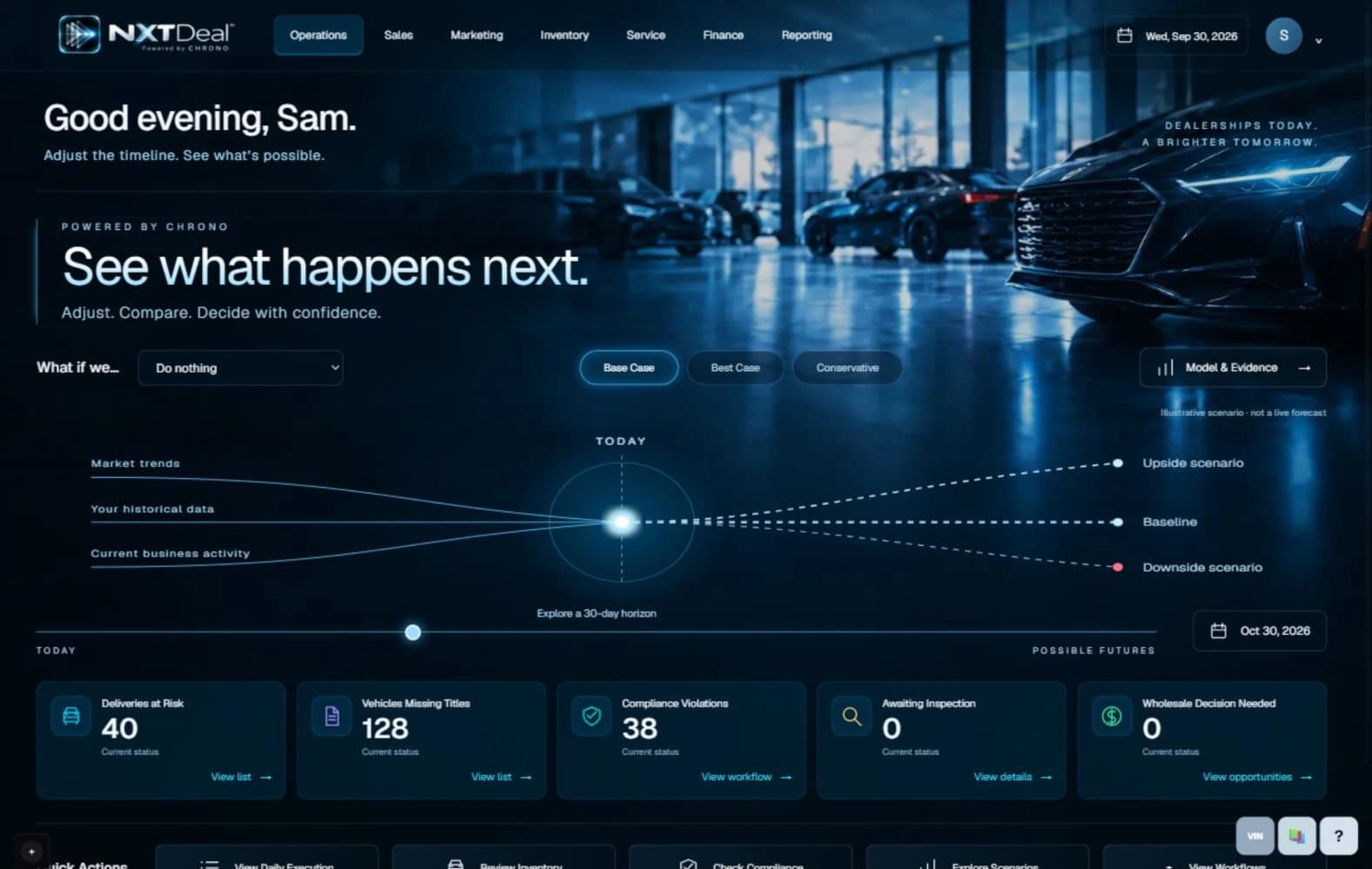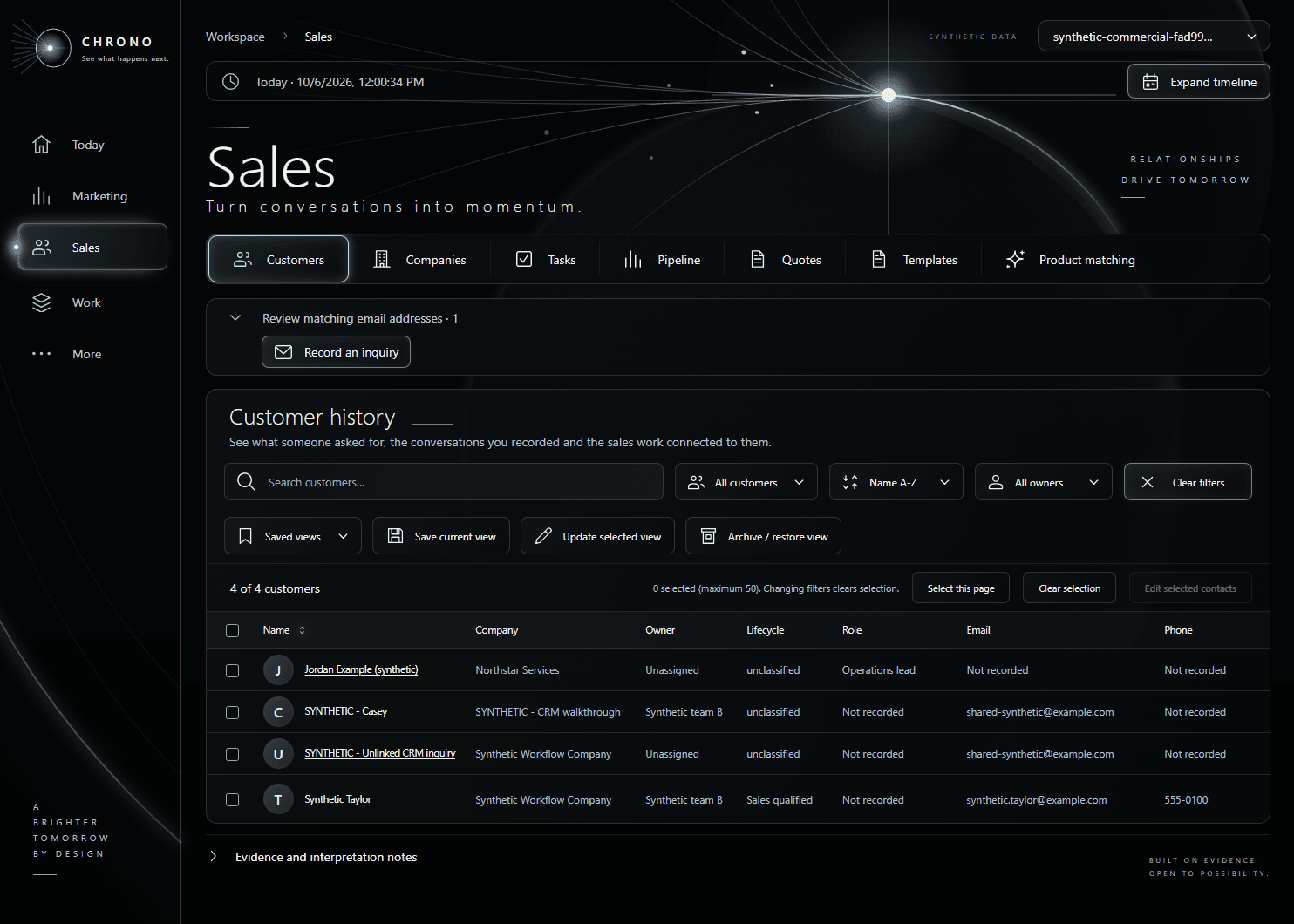
Chrono began with a question I still care about: what happens to the reasoning behind a decision after everybody moves on?
Businesses are very good at displaying the current number. They are less good at preserving what somebody knew when they made the choice that produced it. An assumption becomes a fact. A forecast quietly becomes a promise. Three months later, everyone remembers having been the sensible person in the meeting.
Convenient little miracle, that.
Chrono explored keeping evidence, assumptions, corrections and outcomes connected over time. It grew into a temporal decision engine, with planning and scenario analysis, a browser workspace, a desktop application and ways to work through an API, command line and optional agent interface. [1]
I ended my active development and released the source. The question remains interesting. The prospect of spending years turning it into another business platform does not.
The idea kept acquiring rooms
Once a system can retain useful context, there are plenty of reasonable places to apply it. Customers. Campaigns. Content. Sales. Revenue. Planning. Each additional area makes sense on its own. Taken together, they start to look very familiar.
You have built another workspace.
That was the uncomfortable part for me. I could believe in the underlying idea and still recognize the shape of the product it was becoming. Software already exists for these jobs, in various combinations, with varying degrees of competence. Reassembling them around a different organizing idea can be worthwhile. It can also absorb all the time you have.
I did not want to mistake the existence of another possible feature for a reason to keep going. A backlog can generate its own gravity. There is always something else to build, and none of it answers whether this is still the work you want to do.
Context matters more than another destination
Working on Chrono sharpened my view of where software is heading. I expect much more of the work to start with an instruction: compare these choices, show what changed, find the assumption we got wrong, prepare the next step. The interface should follow the task.
In that world, preserving context is important. Owning the window someone must open to reach it is much less interesting to me.
That is why I think cloud work hubs are heading toward obsolescence as the center of the experience. The useful machinery may remain behind the scenes. The demand that people inhabit its screens, memorize its navigation and keep feeding its internal workflow becomes harder to justify when they can express the outcome directly.
This is the direction I am betting on, not a claim that every organization has already arrived there. The distinction matters because it explains my decision without turning it into a market report. I do not need every business to stop buying dashboards this afternoon to decide I no longer want to build another one.
Chrono already explored agent and local-model interaction. That made the question more pressing. If the valuable part can be reached in different ways, why should I spend my attention making one increasingly elaborate workspace the center of everything?
I learned more than I expected to carry out
The project gave me a practical education in prompt engineering, development cycles and the differences between coding environments. A useful instruction has to survive contact with the actual implementation. It needs context. It needs boundaries. It needs someone willing to check the result instead of applauding because a screen appeared.
Moving between an engine, an API and different interfaces also changes how you think about a system. The screen is one expression of the underlying work. It is not the entire idea. Once I understood that more clearly, I became less attached to finishing every part of the product I had originally imagined.
I also became less impressed by sheer feature count. A project can keep getting bigger while the reason to keep building it gets smaller. That is an expensive way to avoid making a decision.
The identity and interface work still belong in my portfolio. [2] So does the decision to stop. I learned something, built something substantial and changed my mind about where to go next. I am fine with that being the story.
The code gets a future without requiring mine
Chrono Engine is available on GitHub under the MIT License. The release includes the source, synthetic examples, tests and architecture documentation. Dependencies and separately obtained model weights retain their own licenses. My active development has ended, and community maintenance is not guaranteed. [1]
I would rather give someone with the time and interest a starting point than keep a project locked away because I am no longer the person who wants to finish it. Someone else may want the whole platform. Someone may only want the engine, a concept or a small piece of the implementation. That is theirs to figure out under the published terms.
There is no dramatic funeral here. I am not deleting what I learned or pretending the work never mattered. I am refusing to turn every good exploration into a permanent obligation.
I wanted to understand the idea. I do not want to spend the next several years selling everyone another place to put their work. Both statements can stand without a fucking apology tour.
Sources & further reading
Twenty years in marketing and design, across industries. Still paying attention. Considerably less patient.
More about me ↗